Cargo held in US customs: what to do first
This guide covers US ocean freight, especially FCL and LCL shipments sent to a terminal or Centralized Examination Station (CES). Courier shipments follow a different operating process, which is covered briefly in the FAQ.
A hold can mean three different things:
- CBP hold: CBP pauses release while it reviews entry data, documents, admissibility or a risk flag. The filing broker handles requests for corrections or supporting records.
- CBP exam: CBP orders a physical inspection, ranging from a VACIS/NII scan to a full devanning at a CES. The exam itself may cost $150 to $5,000+, before storage, chassis, drayage or carrier charges.
- PGA hold: FDA, CPSC, FCC, USDA, EPA or another agency holds the shipment under its own rules. A PGA hold can run at the same time as a CBP hold or exam.
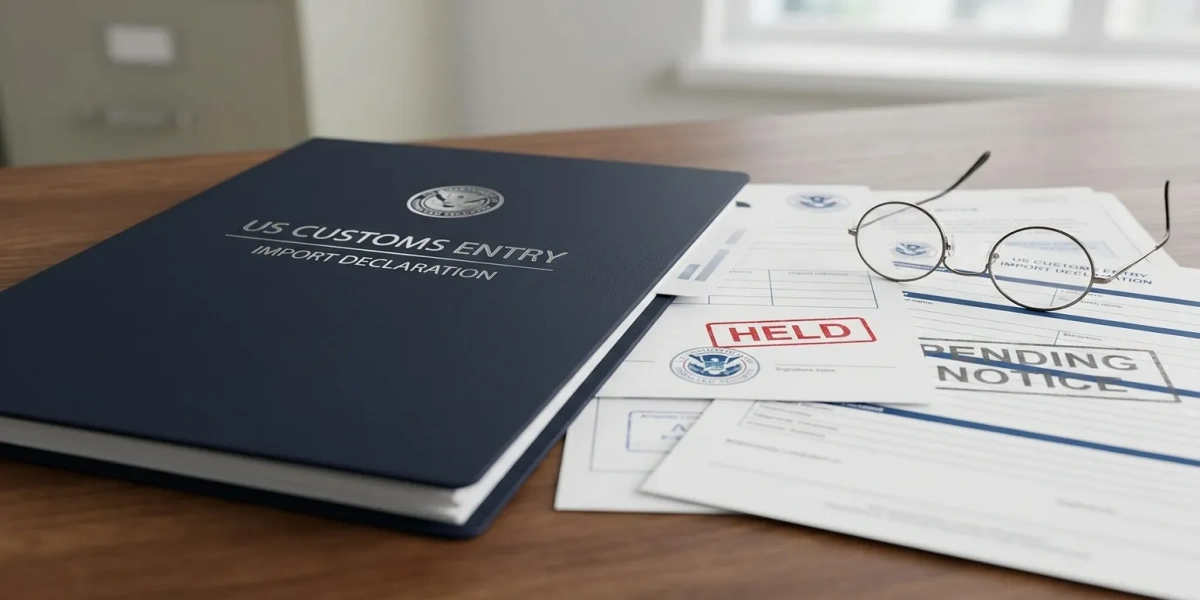
Start with the notice. Confirm the exam or hold type, entry number, container number, current location and named CES. Then contact the broker who filed the entry, gather only the records requested, and ask for the exact last free days for demurrage and detention. Those dates determine when storage and equipment charges begin.
Hold, exam or PGA hold?
The notice determines who needs to act. A document or entry hold goes first to the filing broker. A physical exam requires coordination among the broker, forwarder, carrier and CES. A PGA hold follows the agency named in the notice.
A CBP hold pauses release while CBP reviews the entry, supporting documents, admissibility or a targeting flag. Sometimes the issue is straightforward: an ISF filed late or with mistakes, an HTS code CBP wants to question, a missing document, or a manifest that disagrees with the packing list. But a hold can also involve valuation, origin, intellectual property, forced labor, security or product-admissibility concerns, and it may lead to a physical exam.
A separate entry problem applies from September 18, 2026. CBP may void an Importer of Record number when its Form 5106 data is inaccurate or incomplete under 91 FR 53627. No entries can be filed under that number while it remains void. CBP says reinstatement takes about five business days after it receives a corrected Form 5106 and supporting records (CBP’s voided importer record FAQs). If the broker says the shipment cannot be entered, ask whether the IOR number is active.
A CBP exam is a physical inspection. The cargo may be scanned, opened or fully unloaded. Common descriptions include a VACIS/NII scan, a tailgate inspection and an intensive exam at a CES. CET or A-TCET identifies an enforcement team or hold, not a standard level between tailgate and intensive. The notice may direct a limited inspection or a full CES devanning, depending on the port and case. The broker and forwarder can supply records and coordinate transport, but they cannot cancel the exam or control the CES queue.
A PGA hold comes from an agency other than CBP. FDA may request a food facility registration, CPSC a children’s product certificate, FCC an equipment authorization, or USDA an agricultural inspection. These agencies apply their own requirements, and their review can run alongside a CBP hold or exam. For example, a shipment of power banks may face a CBP valuation question while FCC authorization and UN38.3 battery records are also under review. CPSC’s import shipment tracking tool shows status and remaining review time when the user enters the entry number and filer code.
Is your shipment already ship?
Read the notice or get three fields
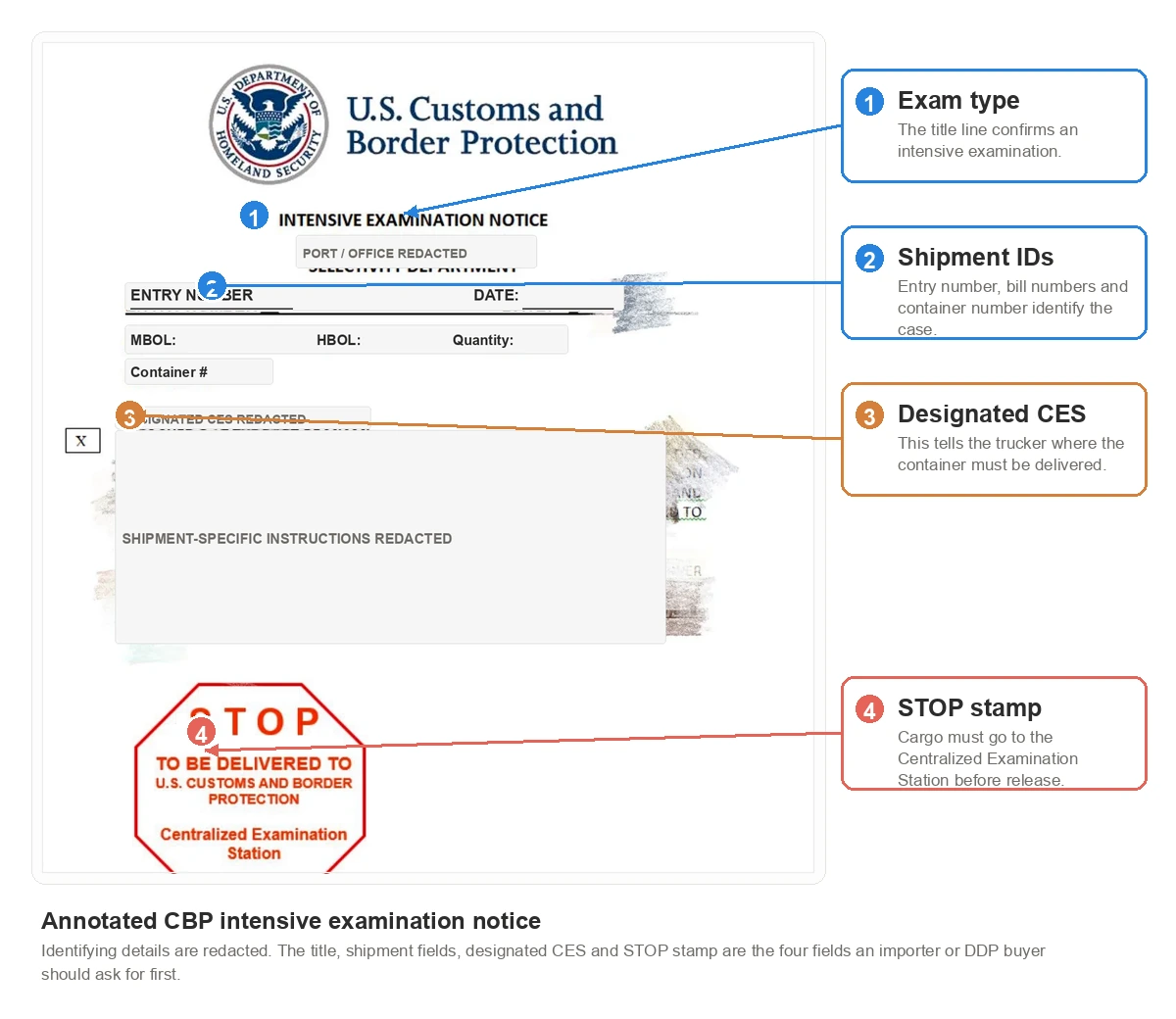
Ask for the actual notice, not a phone summary. The title gives you the exam type. The entry number and container number identify the shipment, and the named Centralized Examination Station (CES) tells you where the box is going. At gateways such as Los Angeles/Long Beach and New York/New Jersey, the CES or carrier controls the transfer and queue.
The terminal or CES usually issues the exam notice. CBP forms such as Form 28, Form 29 and Form 6051D normally appear later, if CBP finds a problem. If you bought DDP and aren’t entitled to the original notice, don’t lose days chasing it. Get the exam type, CES and entry number instead.
Who can see the hold
The broker who filed the entry sees the hold in ACE. The terminal or CES sends the exam notification to the party named on the bill of lading, often the US destination agent. If we filed the entry, we can usually get the notice quickly. If we didn’t, we may have to obtain it through that agent.
DDP buyers are often one or two handoffs away. Ask the seller to pass the request to the US broker or destination agent, and check carrier or terminal tracking with the container number. A useful status update includes the exam type, current location and key dates.
What to do in the first 48 hours
Under FOB, the importer and broker usually receive the notice directly. Under DDP, it often reaches the seller’s US forwarder or broker first. If possible, obtain the US broker’s contact details and the entry number before the shipment arrives.
- Identify the hold: get the notice. If it is unavailable, ask for the exam type, CES and entry number.
- Send it to the correct party: the filing broker handles entry data and document requests. The broker and forwarder coordinate transport to an exam. PGA holds follow the relevant agency’s process.
- Check the entry before sending evidence: prepare the invoice, packing list, contract, payment records and certifications requested by the broker. Confirm that the seller and declared value on those records match the filed entry.
- Prepare for release: record the demurrage and detention expiry dates. Arrange pickup and empty return before release if the likely timing is known.
- Handle cost responsibility separately: US rules place examination costs on the importer (19 CFR 151.6). A DDP contract should state whether the seller absorbs those costs. Our DDP guide explains what to confirm before booking.
Send this message on day one:
About container [number]: (1) Please send the hold or exam notice. If it is unavailable, confirm the exam type and named CES. (2) What is the entry number? (3) What are the exact demurrage and detention free-time expiry dates? (4) Is FDA, CPSC, FCC, USDA or another agency also holding the shipment?
Send it to your forwarder if you bought DDP service directly. If DDP is part of the supplier’s sales contract, send it to the seller for immediate forwarding to the US broker or destination agent.
Customs exam types, costs and timelines
Industry guidance generally describes three primary physical exam formats: VACIS/NII, tailgate and intensive. CET or A-TCET is better understood as an enforcement-team or hold designation, not a fixed fourth level of inspection. A CET hold may result in a limited physical check or an intensive CES exam, so the operational instruction on the notice matters more than the acronym. The planning ranges below draw on published industry fee guidance from licensed brokers and forwarders. Actual invoices vary by port and CES, so treat these as planning numbers, not quotes.
| Exam type | What happens | Typical fee range | Typical delay | Real-world delay |
|---|---|---|---|---|
| VACIS / NII | Container X-rayed at the terminal, never opened | $150–350 | ~1 day | 1–3 days |
| Tailgate | Container opened at the terminal, officers look inside, minimal unloading | $300–500 | 1–3 days | Up to a week |
| Intensive (CES) | Container trucked to a Centralized Examination Station and fully devanned | $1,500–5,000+ | 7–14 days | 3–6 weeks reported, longer with lab testing |
If the notice says CET or A-TCET, do not estimate cost or delay from that acronym alone. Ask whether the operational instruction calls for a terminal check, a limited physical inspection or a full CES devanning. That instruction sets the practical cost and timeline.
The delay ranges separate examination time from the queue around it. An intensive exam may take 7–14 days to process after the container reaches the CES, but congestion can extend the total delay to three to six weeks. Laboratory testing for products such as electronics, toys or cosmetics can add another 10–14 days.
The notice matters because a VACIS scan and an intensive exam have very different cost and timing profiles. Budgeting $300 and one day for a shipment ordered to a full CES devanning can understate the examination cost by roughly ten times, before storage and carrier charges. Use the operation named on the notice, rather than a verbal description such as “X-ray” or “customs check.”
The exam fee is only one charge
Demurrage, detention and related equipment charges may continue during an examination. MSC’s published US terms, for example, state that detention applies “while the container is undergoing U.S. customs examination.” Carrier rules differ. Some start detention from release when a container is held at an off-dock customs facility, while the terminal or warehouse bills storage separately. Check the bill of lading and the carrier’s current tariff for the shipment.
Once free time expires, demurrage at US ports often ranges from $75 to $300 per container per day and may increase in tiers. Per diem commonly starts around $125 to $175 per day. Over several weeks, these charges can exceed the examination fee.
One intensive exam we handled at the New York/New Jersey gateway shows the full cost chain. The CES invoice totaled $3,514.80. The exam charge was $1,295; other lines included fuel, drayage, facility and processing fees, labor, a lift, and 35 days of chassis rental at $35 per day. After 11 working days of free time, the carrier billed another $3,060 in per diem for 17 chargeable working days. The documented total was about $6,575 over roughly six weeks.
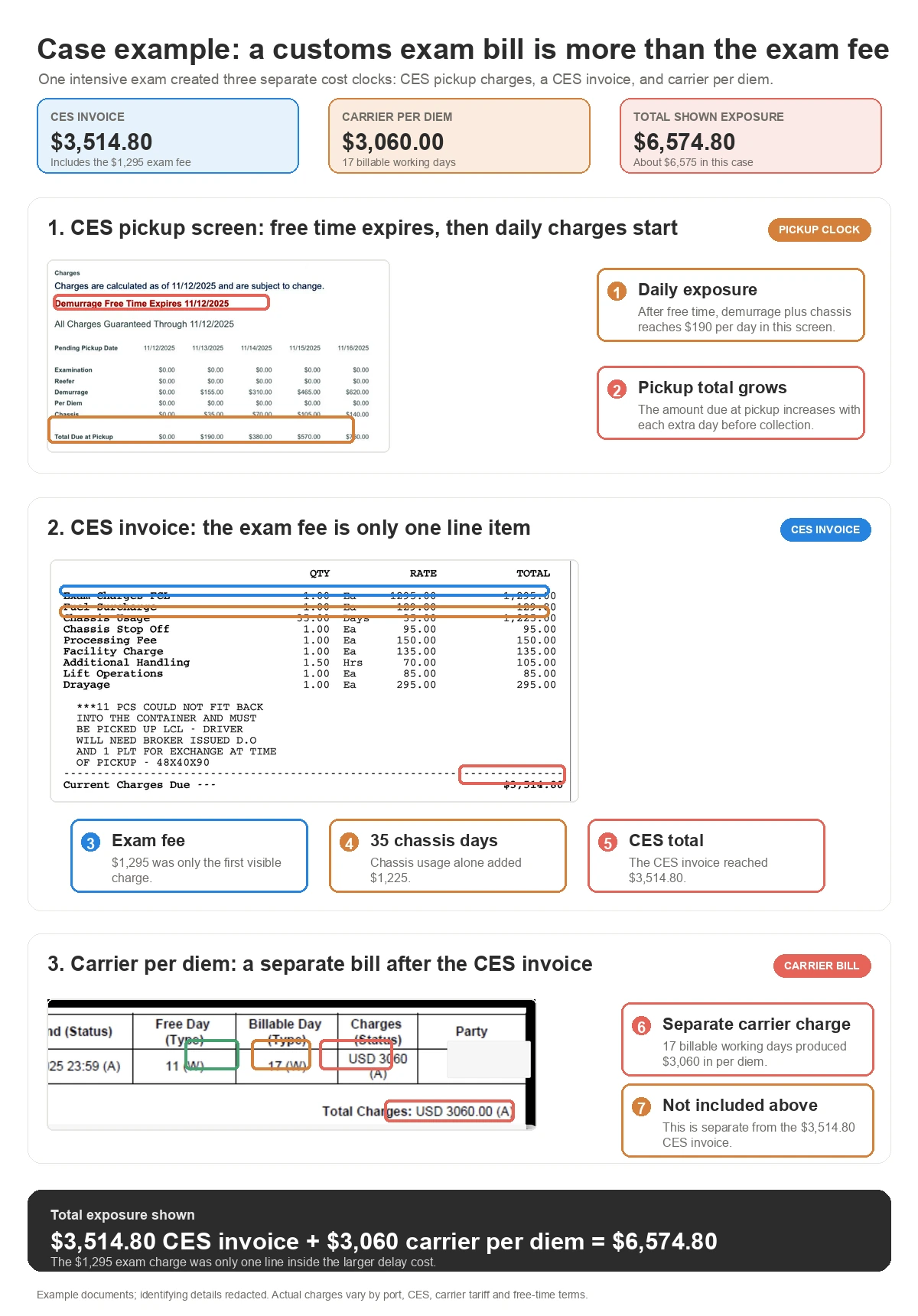
The same shipment also required an unusual pickup arrangement. Eleven cartons did not fit back into the container after devanning, so the CES re-palletized them. Collection required both a container truck and an LTL truck, a broker-signed delivery order and exchange pallets. Before release, the CES also required a Guarantee Letter covering accrued carrier per diem. Only a company with an account on the CES portal could issue it, so the booking forwarder’s US agent provided the letter. Ask about CES account requirements before release if per diem is accruing.
Use the case to check three parts of your own shipment:
- Free-time dates: ask separately for the last free day for demurrage and detention. The clocks may follow different rules, so “11 free days” is not precise enough.
- Release arrangements: line up the trucker, pickup appointment, delivery address and empty-return slot while the container is at the CES. If the cargo was re-palletized, ask whether a second truck, exchange pallets or a Guarantee Letter will be required. If charges approach the cargo value, compare continued recovery costs with abandonment before more daily charges accrue. Abandonment does not erase existing charges.
- Invoice review: the CES or carrier may require payment before release, leaving corrections to be pursued afterward. Compare the CES invoice with the carrier’s per diem statement. Check for duplicated days, chassis billed after return, an incorrect free-time date, or the same exam charge billed again as handling.
Under the FMC’s rules, a demurrage or detention invoice generally must be issued within 30 days of the last charge, include required data, and give you at least 30 days to request mitigation, a refund or a waiver (46 CFR part 541). Put every correction in one email and ask for a revised invoice. For a larger claim, the FMC offers an informal small-claims procedure for claims up to $50,000.
How LCL exam costs are allocated
When CBP examines a consolidated LCL container, the consolidator may allocate examination and devanning costs among the importers in that container, often by volume or weight. A compliant shipment can therefore be delayed and billed when another shipment in the same container triggers the exam.
Incoterms do not remove this operational risk. An FCL shipper is exposed to its own container and declarations. An LCL shipper also shares the examination process and allocated costs of the consolidated container.
Most LCL containers clear without a physical exam, so this is not a reason to avoid LCL by itself. It is a billing term to check before booking and verify if an allocation arrives:
- Before booking, ask the consolidator or NVOCC whether exam and devanning charges are allocated by CBM, weight or another method, and whether it provides the CES invoice.
- Use specific product descriptions, reviewed HTS codes and timely ISF data. Clean records cannot prevent another shipment from triggering an exam, but they reduce delays tied to your own cargo.
- If an allocated charge arrives, request the CES invoice and allocation method. Check your share against the shipment’s CBM or weight before paying.
If the case escalates
Most exams end with release. Detention, civil penalties, seizure and forfeiture are separate outcomes, not four stages of one process.
- Detention: CBP or a partner agency needs more information or suspects the goods may not be admissible. Common triggers include missing licenses or certifications, unresolved value or origin questions, possible forced-labor links, safety concerns, or lab testing. A Form 6051D detention notice means CBP is still deciding; it doesn’t by itself mean the goods will be seized.
- Civil penalty or liquidated damages: Money can be assessed even if the cargo is eventually released. Under 19 U.S.C. 1592, materially false statements or omissions caused by negligence, gross negligence or fraud can lead to civil penalties. Typical examples are undervaluation, misclassification, false country of origin or manufacturer, and hiding goods subject to antidumping or countervailing duties. A bond breach, such as certain filing failures, may produce liquidated damages instead. CBP lists these common trade violations.
- Seizure: CBP takes legal custody of the goods when it believes the merchandise itself is prohibited or was introduced contrary to law. Counterfeit goods, concealed or smuggled merchandise, prohibited items, and serious evasion or health-and-safety violations are common triggers. A classification or valuation mistake doesn’t automatically mean seizure; many cases end with extra duties, a correction or a penalty instead.
- Forfeiture: Seizure is the start of the property case. Forfeiture is the permanent loss of the goods after the administrative or court process, or when nobody successfully contests the seizure. The goods may then be destroyed, sold or otherwise disposed of by the government.
The path is not always exam → detention → penalty → seizure → forfeiture. CBP can release the cargo and assess a penalty later, or seize prohibited goods without first issuing a monetary penalty.
If you receive a seizure, penalty or liquidated-damages notice, the case normally goes to the Fines, Penalties and Forfeitures (FP&F) office. Follow the deadline printed on the notice; seizure petitions are commonly due within 30 days and can be filed through CBP’s ePetition platform. A separate protest may be available for certain CBP decisions, generally within 180 days of liquidation.
If you bought DDP, first identify the Importer of Record and the party named in the notice. If your forwarder or seller’s entity is the importer, you may not be the party entitled to petition. For a low-value shipment, legal fees can exceed the cargo value; for meaningful cargo, duty or penalty exposure, involve an experienced broker or customs attorney immediately. Do not re-route, re-label or re-declare cargo that has already been flagged.
Is your shipment already ship?
Reduce avoidable exam delays
CBP decides whether to examine a shipment, but importers can reduce preventable document and compliance problems.
Check product-specific requirements before shipping. UFLPA high-priority sectors include steel, aluminum, PVC, seafood and lithium. Steel and aluminum may also face Section 232 measures, while food, cosmetics, toys and electronics can require records from agencies such as FDA, CPSC or FCC. Keep the applicable registrations, test reports and authorizations available before arrival.
Entry data should agree across the IOR record, commercial invoice, packing list, ISF and supporting payment records. Use specific product descriptions and reviewed HTS classifications. The same pre-shipment review covers checking duty layers before the shipment sails: a classification or duty-rate question at the border can hold the cargo just as a missing document can. If a shipment has a fixed delivery deadline, allow time for an exam or send the time-sensitive portion earlier or by air. Splitting cargo does not reduce the probability of an exam, but it can limit the amount delayed in one container.
Our import documents guide covers invoice descriptions, line-level HTS information and ISF data. The China to USA shipping guide covers product compliance by category.
FAQ
How long does a customs exam take?
VACIS often clears in 1–3 days, while a tailgate exam can take several days. An intensive exam may take 3–6 weeks when the CES queue is included. Laboratory testing can add another 10–14 days. If the notice says CET or A-TCET, ask what physical inspection was ordered because the acronym alone does not set the timeline.
Who pays for a customs exam under DDP?
US rules charge examination expenses to the Importer of Record. A DDP contract should identify the importer and state whether the seller absorbs the expense. See our DDP guide.
What is the difference between a hold and an exam?
A hold pauses release while CBP reviews entry data, documents, admissibility or a risk flag. Some holds clear without a physical inspection. An exam means CBP physically inspects the cargo. FDA, CPSC or another PGA can place a separate hold at the same time.
What are VACIS, CET and intensive exams?
VACIS/NII is a non-intrusive scan. An intensive exam sends the container to a CES for full devanning. CET or A-TCET identifies an enforcement team or hold, not one fixed physical exam. Check the operational instruction on the notice.
Can a forwarder speed up a customs exam?
A forwarder can coordinate documents, transport and pickup, but cannot cancel a CBP exam or move a container ahead of the CES queue.
Does free time stop during an exam?
Do not assume it stops. Check the bill of lading and obtain the exact demurrage and detention expiry dates. Review the final invoice under the FMC billing rules in 46 CFR part 541.
Do DHL, UPS and FedEx shipments follow the same process?
The same value, classification and PGA questions may apply, but the courier usually acts as broker and requests information through its own system. This article’s CES, chassis and container-cost sections apply mainly to ocean freight.
What do tracking codes such as 1H or 1I mean?
They are operational hold and release codes, not exam types. Ask the filing broker what is held and what action is required.


