Incoterms version note: This article refers to the ICC Incoterms® 2020 rules. FCA can be used for any transport mode, including sea, air, truck, rail, courier, and multimodal shipments. FOB is designed for sea and inland waterway transport only.
FCA vs FOB: The Short Answer
Use FCA when the shipment is air, courier, rail, multimodal, or handed to a buyer-nominated warehouse or carrier before vessel loading. Use FOB only for sea or inland waterway shipments when the seller can deliver the cargo on board the vessel at a clearly named port. For container shipping from China, the better choice depends on the actual handoff point—not simply on which term the supplier normally uses.
When a supplier in China quotes FOB, but a buyer or overseas forwarder asks for FCA, the issue is rarely as simple as the textbook definitions in Incoterms explained.
On paper, the difference is simple:
- FCA means the seller delivers the goods to the buyer’s carrier or another named place.
- FOB means the seller delivers the goods on board the vessel at the named port of shipment.
In China export practice, FOB carries extra operational weight: nominated-forwarder workflows, China-side agent coordination, and export-declaration habits. FCA is technically cleaner for air, courier, multimodal, and warehouse handoffs — but it is rarely the default in Chinese supplier or finance language.
Which Term Fits Your Shipment?
Choose FCA for air, courier, rail, multimodal shipments, or when the actual handoff occurs at a forwarder warehouse, terminal, or carrier facility.
Choose FOB only for sea or inland waterway shipments when the seller delivers the goods on board the vessel at a named port.
The key difference: FCA transfers risk at the named carrier handoff; FOB transfers risk only after the goods are loaded on board.
| Your situation | Better term | Why | Watch out |
|---|---|---|---|
| Air, courier, or express shipment | FCA | FOB does not apply to air freight | Name a real handoff point such as an airport cargo terminal or forwarder warehouse |
| Buyer-nominated China warehouse handoff | FCA | Naming a real warehouse is easier to execute | Avoid vague wording like FCA China |
| FCL ocean freight with a clean carrier handoff | FCA can be cleaner; FOB still workable | FCA risk transfer can align with the carrier handoff | Confirm named port, cutoffs, and B/L process either way |
| LCL ocean freight via a forwarder consolidation warehouse | FCA at the forwarder warehouse | The real handoff is the warehouse, not the vessel | Name the actual consolidation warehouse |
| Standard China sea freight with an established nominated forwarder | FOB | The workflow is familiar and executable on both sides | Confirm named port, local charges, B/L draft, and insurance boundary |
| Supplier insists on FOB on the PI for tax-rebate or finance reasons | Confirm internally before changing | The commercial Incoterm and customs declaration basis may not need to match | Align broker, finance, and customer before issuing the PI |
| Customer rejects FOB because the shipment is not ocean freight | FCA or another multimodal term | FOB cannot be stretched to air, courier, or rail | Update the PI and confirm export-clearance responsibility |
What FCA and FOB Mean
FCA (Free Carrier) means the seller delivers the goods, cleared for export, to the buyer’s carrier or another named place; risk transfers at that handoff. The named place is everything — a vague FCA China tells no one where responsibility changes, so name a real forwarder warehouse, terminal, or carrier facility.
FOB (Free On Board) is for sea and inland waterway transport only. The seller delivers on board the vessel at the named port (e.g. FOB Yantian, Incoterms 2020), and risk transfers when the goods are loaded.
The practical difference is where risk transfers. For containerized cargo, the physical handoff usually happens before loading — at a warehouse, terminal, or container yard — so FOB can leave a gray zone between handoff and on-board loading, while FCA can match the real handoff point. ICC Academy’s FCA-or-FOB guidance likewise distinguishes FCA delivery at an agreed carrier handoff from FOB delivery on board the vessel.
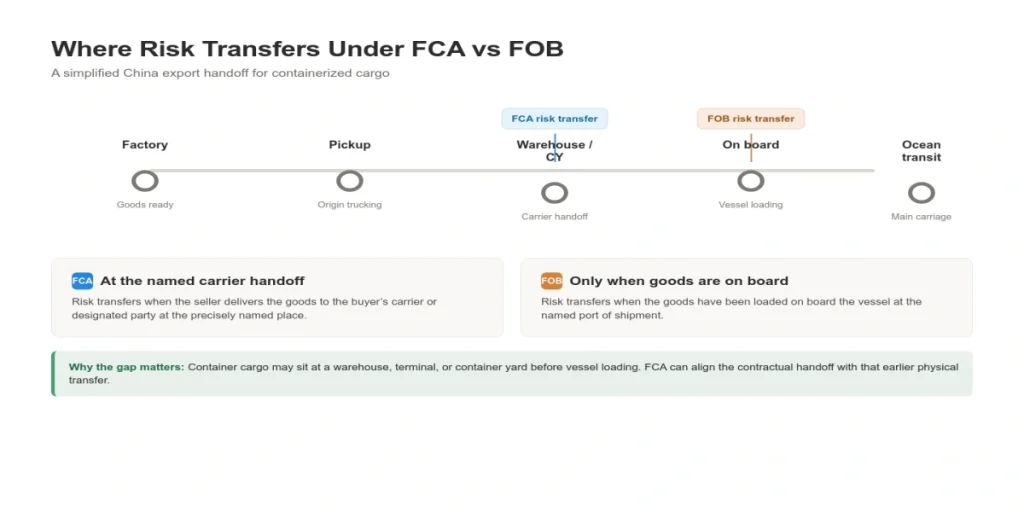
Illustrative example: the actual FCA risk-transfer point depends on the precise named place in the sales contract.
The full container-gap discussion — the CY waiting window, and how warehouse-to-warehouse insurance, FOB Contingency, or an FCA switch can close it — is in the FOB Shipping from China guide.
Why FCA Is Cleaner for Air, Multimodal, and Warehouse Handoffs
FCA is usually cleaner in two situations.
1. Air freight, courier, and multimodal shipments
For air, courier, or multimodal shipments, use FCA at a real handoff point — a forwarder warehouse, airport cargo terminal, or carrier facility. If a supplier writes FOB airport, ask whether they actually mean FCA at that named place.
2. Buyer-nominated warehouse handoff
If the buyer or overseas forwarder nominates a China-side warehouse, FCA can name that warehouse directly. The seller delivers to a real location, and the buyer’s freight arrangement takes over from that point.
This is especially useful when the China forwarder has established receiving points.
Why FOB Is Still Common in China Ocean Freight
FCA may be technically cleaner in many cases, but FOB remains common in China ocean freight for practical reasons.
1. FOB is tied to nominated-forwarder practice
Most China FOB shipments run through a nominated-forwarder chain, which keeps FOB the default ocean-freight term among Chinese suppliers even when FCA might be technically cleaner. The section below covers how that structure works in practice.
2. FOB is familiar and workable when written clearly
Many suppliers and finance teams are used to FOB in export files, especially for ocean freight; internal systems or tax-rebate documentation may also push toward FOB language. That is fine — FOB can still work well for China ocean freight if the shipment scope is clear:
- named port
- Incoterms version
- nominated forwarder
- China-side agent
- included and excluded origin charges
- B/L draft process
- cutoff dates
- insurance boundary
A well-managed FOB shipment is better than a vague FCA shipment.
The China Nominated-Forwarder Issue
This section reflects first-hand experience handling FOB shipments from China and is not a legal interpretation of Incoterms 2020 obligations.
FOB shipments from China often involve a nominated forwarder.
A typical structure:
- The overseas buyer or consignee works with an overseas forwarder.
- The overseas forwarder nominates a China-side agent.
- The China-side agent contacts the factory.
- The factory delivers cargo or documents according to the China agent’s instructions.
- The China agent coordinates China-side handling, warehouse, declaration, port, and document work.
- The overseas forwarder controls main freight and destination-side arrangements.
This structure can work well, but only if the parties understand who represents whom.
The China-side agent may not know the consignee directly. The agent may be working under the overseas forwarder. If local charges appear high or unclear, the factory should ask for a breakdown and confirm who authorized the charges. If the fees are unreasonable, the factory can push back through the consignee or ask the overseas forwarder to nominate another China-side agent.
This is why communication quality matters. In FOB nominated-forwarder shipments, the China-side forwarder is not just moving documents; they are often the bridge between the factory, overseas agent, and shipping process.
Can the PI Say FCA While Customs Declaration Uses FOB?
Process reminder, not legal or tax advice. Whether the commercial Incoterm on the PI can differ from the term used on the export declaration or tax-rebate file depends on the exporter’s local compliance practice, customs broker, and finance team. Always confirm with the customs broker and finance team before changing PI wording.
A common China-side question is:
Can the customer-facing PI say FCA, while the China customs declaration or tax-rebate file uses FOB?
The answer depends on the exporter’s local compliance practice, customs declaration method, tax-rebate documentation, supporting invoices, and internal finance requirements.
But the process rule is clear:
The commercial Incoterm, customs declaration basis, and export tax-rebate file are related, but they are not the same document problem.
A foreign customer may care about the commercial Incoterm because it defines responsibility and handoff. A China finance team may care about the declaration and rebate file because it needs a complete domestic evidence chain. A customs broker may care about how the export declaration is filed.
Before forcing the customer-facing PI to use a term the customer rejects, the exporter should confirm:
- What term did the customer agree to commercially?
- What transport mode is actually being used?
- What does the customs broker need for declaration?
- What does finance need for export tax-rebate documentation?
- What supporting invoices are required?
- Can the document chain be explained if reviewed?
- Who internally approves the final wording?
This is especially important for first-time tax rebate or first-time export review situations. Sales, finance, the customs broker, and the forwarder should not make separate assumptions.
FCA vs FOB Responsibility Table
| Item | FCA | FOB | Why it matters |
|---|---|---|---|
| Transport mode | Any mode | Sea / inland waterway only | FOB should not be used for air or courier shipments |
| Export clearance | Seller normally handles export clearance | Seller normally handles export clearance | Both are usually cleaner than EXW for foreign buyers |
| Delivery point | Named place / carrier handoff | On board the vessel at the named port | FCA can match warehouse or carrier handoff more naturally |
| Main freight | Buyer | Buyer | Both can support buyer-controlled freight |
| Risk transfer | When goods are delivered to carrier / named place | When goods are loaded on board vessel | FOB can create a gap before loading |
| Named place wording | Must name the handoff place | Must name the port of shipment | Vague wording causes disputes |
| B/L issue | May need on-board notation coordination | Often aligns with traditional ocean B/L practice | Important for LC or bank document requirements |
How to Write FCA Shanghai or FOB Yantian Correctly
The city or port name should identify the actual contractual delivery point—not just provide a general location. For FCA, include the specific warehouse, terminal, carrier facility, or address whenever possible.
| Wording | Is it clear? | What to change or confirm |
|---|---|---|
FCA China | No | No handoff point is identified. Name the exact facility and city. |
FCA Shanghai | Usually too vague | Add the warehouse, airport cargo terminal, container yard, or full address. |
FCA [Warehouse Name and Address], Shanghai, Incoterms 2020 | Clearer | Confirm whether the seller must load or deliver ready for unloading at that named place. |
FOB China | No | FOB must identify the named port of shipment. |
FOB Yantian, Incoterms 2020 | Correct format | Still confirm origin charges, cutoffs, nominated forwarder, B/L process, and insurance boundary. |
FOB Shanghai Airport | Incorrect | FOB does not apply to air freight; use FCA at the named airport cargo terminal or carrier facility. |
Before accepting either term, confirm:
- Exact Incoterm and Incoterms version
- Named place or named port
- Who handles export clearance
- Who appoints the forwarder
- Who the China-side agent is
- Which local charges are included or excluded
- Where cargo insurance starts
- Whether B/L or on-board notation is needed
- Who approves the final PI, customs, and finance wording
Common Mistakes
Mistake 1: Writing only “FOB China”
FOB must name the port of shipment. “FOB China” is too vague.
Mistake 2: Writing FCA without a real named place
FCA needs a real handoff location. A specific forwarder warehouse or terminal is better than a vague city name.
Mistake 3: Assuming FOB means all China-side costs are included
FOB does not automatically include every local charge. Confirm origin charges in writing, and use the FOB Shipping guide for a full origin-charge breakdown.
Mistake 4: Thinking FCA is always better because it is technically cleaner
FCA may be cleaner, but the seller must be able to execute it, document it, and align it with export clearance and finance requirements.
FAQ
Is FCA better than FOB?
It depends on transport mode and handoff point. FCA is better for air, courier, multimodal shipments, and many carrier-handoff situations. FOB is still common for China ocean freight. The better term depends on transport mode, handoff point, documents, and whether the supplier can execute the term clearly.
Why does ICC guidance often point container shipments toward FCA?
Because container cargo is often handed to a carrier, terminal, or forwarder before it is loaded on board the vessel. ICC Academy’s FCA-or-FOB guidance explains why FCA can align delivery and risk transfer with that actual carrier handoff, while FOB waits until the goods are on board.
Can I use FOB for container shipping from China?
Yes, but write it carefully. FOB is still widely used for China ocean freight. It should be written clearly with a named port, Incoterms version, nominated forwarder, origin charge scope, cutoff process, B/L process, and insurance boundary.
Is FOB only for sea freight?
Yes. Under Incoterms 2020, FOB is for sea and inland waterway transport. It should not be used for air, express, courier, truck, or rail shipments.
Who pays freight under FCA and FOB?
In both FCA and FOB, the buyer usually controls and pays the main freight after the seller’s delivery point. Local charges, export handling, warehouse fees, and document fees still need to be confirmed separately.
Who handles export clearance under FCA and FOB?
The seller normally handles export clearance under both FCA and FOB. This is one reason both terms are often cleaner than EXW for foreign buyers importing from China.
Does FCA solve the bill of lading problem?
Not always, but Incoterms 2020 built in an optional solution. Under documentary-credit practice, a bank may require an on-board bill of lading. FCA A6/B6 allows the parties to agree that the buyer will instruct the carrier to issue an on-board bill of lading to the seller after loading. This still requires coordination among the buyer, carrier, seller, and bank, so confirm the credit and document flow before finalizing the term. The ICC Academy FCA-or-FOB guidance explains this FCA option, while ICC’s UCP 600 publication notice provides the official background on the documentary-credit rules.
Should I ask my Chinese supplier to change FOB to FCA?
Ask if the shipment is air, express, multimodal, or if the real handoff is a nominated forwarder warehouse before vessel loading. But if the shipment is standard ocean freight and the supplier’s FOB process is clear, FOB may still be workable.
What is the difference between EXW, FCA, and FOB?
EXW, FCA, and FOB are three of the 11 Incoterms 2020 rules. EXW gives the buyer the most China-side responsibility. FCA lets the seller handle export clearance and deliver to a named carrier or place. FOB is sea-only and transfers risk when the goods are loaded on board the vessel.
Closing
The safest term is the one where every handoff, cost, document, and responsibility is clear before the cargo leaves the factory. Keep the customer-facing Incoterm, customs declaration basis, and tax-rebate file aligned across the exporter, broker, forwarder, and finance team.
Sources & References
- ICC Incoterms® 2020 rules — the governing standard for FCA and FOB.
- ICC Academy: Incoterms® 2020 — FCA or FOB? — delivery points, transport-mode scope, and the FCA on-board B/L option.
- ICC: UCP 600 publication notice — official background on ICC documentary-credit rules.