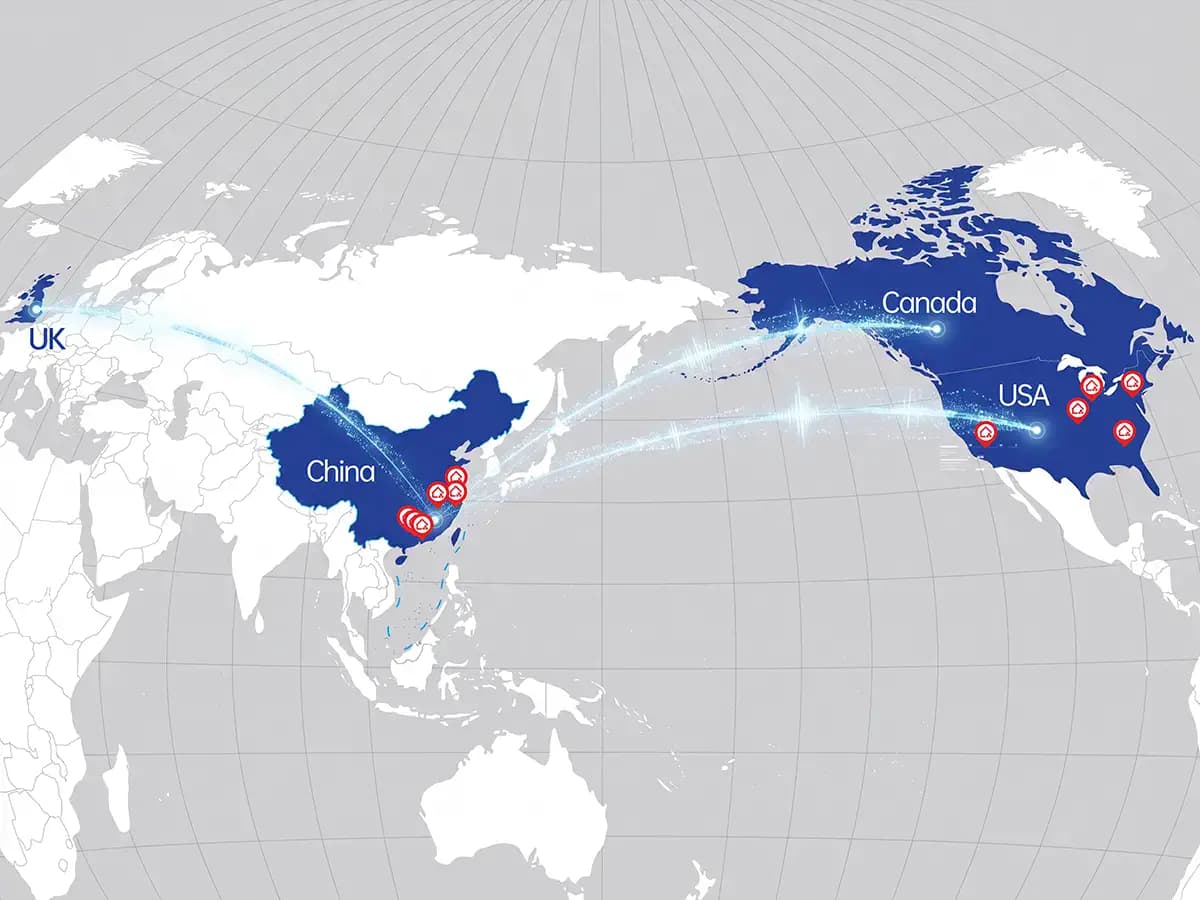
Where We Handle FOB Shipments
FOB service on the lanes we run most — appointed-forwarder handling, itemized origin charges, and SI / VGM / CY cutoff tracking as standard.
Most guides open with the same line: Free On Board — risk transfers once the goods are loaded on the vessel. True, and also not the part that actually costs first-time importers money. FOB’s real trap sits in the gap between that definition and the invoice: the term tells you where risk passes, but buyers instinctively read it as where their cost stops. Those are two different lines, and they rarely land in the same place. Suppliers quote FOB casually, forwarders price it inconsistently, and ICC guidance now points to FCA as the cleaner rule for containerized cargo — yet FOB remains the default on nearly every China–U.S. lane anyway.
Two ways to read this: Already shipping and just want to sanity-check a quote? Jump straight to What Your FOB Price Actually Includes. New to FOB? Read start to finish — each section flags a decision that resurfaces as a cost or a delay later on.
Three things decide whether FOB goes smoothly for you: who actually controls booking, who’s responsible during the gap between factory and vessel, and whether your forwarder discloses origin charges before you commit. Get those three right and FOB does exactly what it promises.
Here’s how that plays out in practice. A supplier sends a clean “FOB Shenzhen” unit price, and the importer reads it as “everything up to the ship is handled — my only job left is ocean freight.” Then, after booking, a separate forwarder invoice shows up for terminal handling, documentation, VGM, and telex release. And somewhere in between, a container sitting at the yard turns out to be nobody’s clear responsibility for a few hours or days. The number looked complete. The setup wasn’t.
None of that makes FOB the wrong call — for most SMB importers past their first shipment, it’s still the right one. Get it right and it’s the most transparent, cost-controlled way to import from China. The rest of this guide is built to help you get there.
What FOB Actually Means (and What It Doesn’t)
Under Incoterms 2020, FOB — Free On Board — transfers risk from seller to buyer when goods are loaded on board the vessel at the named port. FOB sits alongside the other 10 rules on the Incoterms Chart, which lays out cost, risk transfer, and mode of transport at a glance.
The way most importers actually think about it: FOB ≈ EXW + inland delivery to the port + origin/loading-port local charges + the supplier preparing export declaration documents. That mental math is roughly right — just remember the origin local charges in that equation are usually billed by the forwarder, not baked into the supplier’s unit price (see §4).
Two things textbooks rarely flag:
“FOB” means different things in different rulebooks
“FOB Shanghai” on a Chinese PI = Incoterms 2020 (international maritime). “FOB Origin” on a U.S. 3PL contract = UCC (domestic). Same letters, different rulebooks. If a quote still talks about risk transferring “at the ship’s rail,” that wording was removed in Incoterms 2010 — a small signal the doc hasn’t been updated in over a decade.
The practical mental model: three phases
Importers usually assume risk transfers in phase 1. It actually transfers between phase 2 and phase 3:
- Factory → port — supplier’s risk.
- At port, before loading (CY waiting) — on paper still supplier’s; in practice, the gray zone (next section).
- On board → destination → your door — your risk, your insurance.
If you remember nothing else: FOB is not a single moment. It’s a handoff inside phase 2 — exact timing depends on containerization, forwarder docs, and what your contract says.
The Container Gap: The One FOB Risk Nobody Warns You About
First, the reassurance: FOB works perfectly well for containerized cargo from China. Millions of containers move on FOB terms every year — you are not doing something wrong by using it. You just need to understand one short risk window that beginner guides skip, and make sure it’s covered.
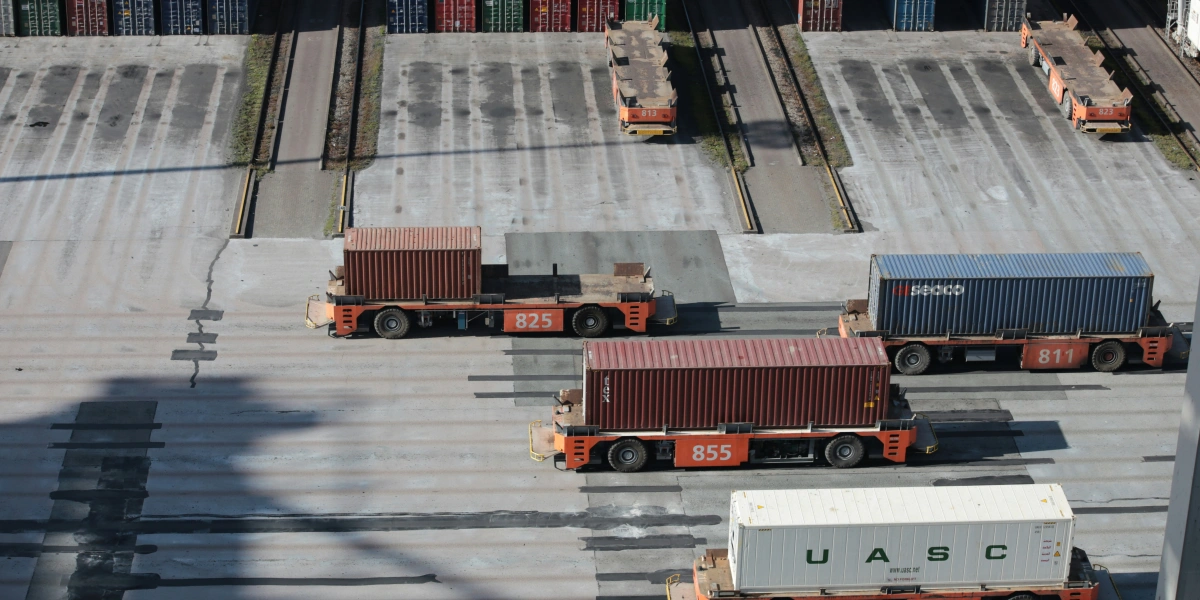
When your goods are sealed in a container sitting at the port’s Container Yard (CY) waiting to be loaded onto the vessel — sometimes hours, sometimes days — your shipment is briefly in a physical and legal gray zone. Your supplier has done their part: trucked the container to the port, handed off the documents, paid the terminal handling charge. On paper you don’t own the risk yet (it transfers only when the box is on board). In practice, during those waiting hours, there isn’t always someone you can call when something goes wrong.
This is the container gap. The good news: once you know it exists, it’s entirely manageable.
What actually goes wrong in the gap
Rare, but real, things that happen to containers during CY waiting:
- Port congestion or typhoon → rolling — the container misses the booked vessel and waits for the next one. Demurrage starts ticking.
- Document errors at the terminal → container is held, sometimes returned to the supplier for re-stuffing.
- Yard handling damage → punctures, dents, seal breaks. Hard to attribute. Insurance disputes follow.
- Customs hold for random inspection → container is opened, inspected, resealed. Cargo can be damaged during inspection.
How to close the gap — this is the part that matters
Two moves, and the first is the one most importers get wrong:
1. Don’t assume your buyer-side W2W insurance automatically covers the pre-loading window. A warehouse-to-warehouse policy may describe coverage from factory to destination warehouse, but a claim still depends on who had insurable interest when the loss happened. Under FOB, if cargo is damaged before it’s on board, your insurer can argue the risk wasn’t yours yet. The fix is simple: confirm in writing which policy — yours or the seller’s — explicitly covers the CY period. (More on this in the forwarder-vetting section.)
2. Appoint a forwarder who actively manages this window. One who tracks CY cutoffs, flags rolling risk early, and knows which side’s insurance sits where closes the gap for you. This is exactly what a competent forwarder does — and a weak one lets slip. It’s the single biggest reason your choice of forwarder matters more than your FOB rate.
Why does this matter more than the rate on your quote? Because a fraction of a cent per kilo won’t sink a shipment — an uninsured gap during CY waiting can. The container gap is a known, coverable risk, not a reason to avoid FOB: confirm which policy covers the pre-loading window, and appoint a forwarder who actually watches it for you.
- “But doesn’t the ICC recommend FCA for containers?” Technically, yes. ICC Incoterms 2020 guidance notes that FOB isn’t ideal for containerized goods and that FCA (Free Carrier) transfers risk earlier and more cleanly — at the terminal handoff, before the gray zone starts. In theory FCA closes the container gap by design. In practice on China–U.S. lanes it’s largely academic: almost every Chinese supplier quotes and operates on FOB, and getting one to switch is rare. If you ship FCL and your supplier is unusually flexible, it’s worth asking — otherwise, FOB run properly (right insurance, right forwarder) is the pragmatic answer. The next section explains why FOB dominates in China.
Why Chinese Suppliers Almost Always Quote FOB (Not FCA)
If FCA is technically cleaner for containers, why does virtually every Chinese supplier still quote you FOB? Not ignorance — five practical reasons drive it, and they’re exactly why FOB is the sensible default on China lanes rather than a habit worth fighting.
- It’s the entrenched market habit. FOB has been the standard China export term for decades. Factory sales teams, forwarders, and export agents price, document, and operate around it by default — FCA simply isn’t in most suppliers’ muscle memory.
- Export VAT rebates are calculated on FOB value. A Chinese supplier’s export tax rebate is figured from the FOB amount, and the customs declaration system records FOB. Quoting FCA adds friction with no upside for them.
- The letter-of-credit legacy. Banks financing trade have long wanted an “on board” Bill of Lading, which FOB produces naturally. (Incoterms 2020 added an on-board notation to FCA to address this, but adoption is slow.)
- It keeps their scope clean. Under FOB the supplier’s job ends at a clear finish line — “loaded on board.” FCA’s “named place” forces both sides to define the exact handoff point, which many suppliers would rather not negotiate.
- Buyers ask for it. FOB is what importers know to request, so the whole ecosystem keeps reinforcing it.
The 8-Step FOB Shipment Process
A clean FOB shipment moves through 8 operational steps. Each step has a primary owner and a specific failure mode if it’s skipped or rushed. Use this as a checklist before your next booking.
| Step | Action | Primary owner | Most common failure |
|---|---|---|---|
| 1 | Contract + Proforma Invoice signed (Incoterm, named port, payment terms, appointed-forwarder clause) | Seller → Buyer | Vague Incoterm wording (“FOB China”) with no named port |
| 2 | Production begins + QC / pre-shipment inspection planned | Seller + Buyer-arranged QC | Waiving inspection on a supplier you’ve never met in person |
| 3 | Forwarder booking + SI / VGM / CY cutoff dates issued | Buyer → Forwarder | Booking before final shipment volume is locked → rebooking fees |
| 4 | ISF data prepared and filed at least 24 hours before vessel loading | Buyer + Broker / Forwarder | Late or inaccurate ISF → CBP penalties, holds, or exams |
| 5 | Container loaded → trucked to port → customs declared → gated in before CY cutoff | Seller + Forwarder | Missing cutoff → rollover (see Step 5 note below) |
| 6 | B/L draft reviewed before sailing → final B/L issued after confirmation | Forwarder + Seller + Buyer | Skipping draft confirmation (see Step 6 case below) |
| 7 | Final payment + document release based on agreed payment terms | Buyer → Seller / Forwarder | Paying or releasing documents before accuracy is confirmed |
| 8 | Vessel departure → arrival → U.S. customs clearance + last-mile | Buyer side | IOR / bond / broker setup not ready before arrival |
Step 5 — what’s not your responsibility: Carrier-caused rollovers (port congestion, mechanical issues, last-minute carrier reshuffles after the container is already at the terminal) usually do not generate fees for the buyer or seller. The carrier handles it. Your only job: confirm the new vessel name + ETA, and update the B/L if the routing affects it. Don’t let a forwarder bill you “rollover handling fees” for something that wasn’t your fault.
Step 6 cautionary case (from a recent shipment we handled): A first-time importer skipped B/L draft confirmation, then asked to change the consignee, seal number, and release method after sailing. The fix wasn’t simple. Changing only the release method costs a telex fee. Changing the consignee after the manifest is filed at destination triggers amendment fees, destination port penalties, and potentially demurrage / storage charges — depending on the destination port’s customs rules and the carrier. The cure is upstream: confirm every field of the B/L draft before the vessel sails. Names, addresses, container numbers, port spellings, HS codes — line by line.
What Your FOB Price Actually Includes — The Origin Charges Trap
Most importers ask one question when comparing FOB quotes: is this number competitive? The question that actually matters is different: is this number complete? The most expensive misunderstanding in FOB shipping is assuming it is — the FOB unit price your supplier quotes is not the total origin-side cost you’ll absorb. The other part usually shows up as a separate forwarder bill, after booking is already confirmed.
Origin cost lives in two buckets
Bucket A — Inland leg (covered by your supplier’s FOB quote, usually):
- Factory → warehouse trucking
- Warehouse receiving / handling at the consolidation point
- Container pickup at the depot
- Inland drayage to the port of loading
Bucket B — Port + forwarder leg (billed separately, usually by the forwarder):
- Terminal Handling Charge (THC)
- VGM filing fee
- Documentation fee
- Customs declaration / export filing
- Port charges
- Telex release fee
- Container seal + equipment
A supplier’s FOB unit price covers Bucket A. Bucket B is what the forwarder bills you separately — and where most first-time importers get caught off-guard.
“Appointed forwarder local charges” — the most common surprise
When you (the buyer) appoint your forwarder, that forwarder bills you for Bucket B at origin. This is standard FOB practice. What’s not standard — but unfortunately common — is the forwarder waiting until after booking to disclose Bucket B totals. That’s how surprise bills happen.
Ask the right question
Most importers ask: “How much is FOB?” That question can’t be answered honestly in one number.
Ask this instead:
What does this FOB price include? Which origin charges will be billed separately by the appointed forwarder? Who pays each?
A serious forwarder will answer in a written line-item breakdown. A non-serious one will quote “all-in” and dodge specifics — a forwarder-vetting signal we come back to later in this guide.
Pricing checklist — confirm before booking
Before you accept any FOB quote, get the following in writing:
- Product unit price + Incoterm (FOB [Named Port])
- Origin local charges — line-item, with payer for each
- Ocean freight basis — FCL rate per container OR LCL rate per CBM / weight tonne
- Currency + payment terms — and which charges are paid where
- Validity window — quotes expire fast; rates shift weekly
- Cutoffs — SI, VGM, CY closing dates
- Explicit exclusions — destination charges, duties, taxes, demurrage
If a quote is missing any of items 1-6, it’s incomplete — not competitive.
Why insist on seeing Bucket B before you book? Because that’s the exact spot where a “complete-looking” quote turns out to be a partial one. A trustworthy FOB quote shows Bucket B in writing before booking — full stop.
Hidden Fees and Destination Charges That Catch First-Time Importers
If §4’s origin charges are the first surprise, destination-side fees are the second. In practice, hidden-fee disputes can appear on either side of the ocean — origin local charges, destination release fees, or both. They’re often billed weeks after the booking, by parties the importer never directly spoke to.
Here’s the pattern that shows up over and over, once you’ve seen enough billing disputes: it almost never looks like outright fraud. It looks like an itemized invoice with eight or nine line items, three different billing bases (per shipment / per B/L / per CBM), and no advance disclosure of any of them.
The fees most often missed in advance
These are the line items that “all-in” FOB quotes routinely leave out:
| Fee | Where it shows up | What it covers |
|---|---|---|
| THC (Terminal Handling Charge) | Origin + destination | Container handling at the terminal. Often double-billed — once at origin, once at destination — without the importer being warned. |
| DO Fee (Delivery Order) | Destination | Release of cargo at the destination terminal. Common surprise on small shipments where DO fee is disproportionate to ocean freight. |
| CISF (Carrier Security Surcharge) | Origin or destination | Carrier-imposed security fee. Inconsistent — some carriers absorb it, some bill it separately, some bill it twice. |
| Document Fee / B/L Fee | Origin | B/L issuance and document handling. Almost always billed; rarely disclosed up front. |
| Telex Release Fee | Origin | Surcharge for electronic B/L surrender. (See §8 for B/L flow.) |
| AMS Fee / Manifest Fee | Origin | Cargo manifest filing to U.S. Customs for the vessel call. Required on U.S.-bound shipments. |
| ISF Filing Fee | Origin | 10+2 advance filing fee to U.S. CBP. Your forwarder files it on your behalf; you pay for it. |
| VGM Filing Fee | Origin | Verified Gross Mass filing fee required by SOLAS regulations. |
| CFS Charges | Origin (LCL only) | Container Freight Station handling for less-than-container-load consolidation. |
A real invoice we recently reviewed had eight separate origin line items for a single 40HQ shipment, billed across three different bases — some per shipment, some per B/L, some per CBM. The total came to roughly US$420 against a cargo value of about US$8,400 — not catastrophic, but for a first-time importer who only saw the “FOB Shenzhen” unit price during quoting, that’s a 5% surprise nobody mentioned in advance.
Three rules that stop most surprises
- Reject single-number quotes. A trustworthy quote is itemized. “All-in” answers without a written breakdown aren’t a price — they’re a vetting signal.
- For every line item, ask four questions in writing: who charges this, when does it bill, is it already included in the FOB unit price, and what triggers it? Save the answers — they become your reference for the next shipment.
- Re-check before booking, and again at arrival notice. Origin charges should be disclosed at booking confirmation; destination charges should match the original quote at arrival notice. If either doesn’t match, ask why before authorizing the next move.
Demurrage doesn’t care whose fault it is. If the destination terminal is congested and your container is at the back of the queue, storage and demurrage clocks start the moment your free days expire — even if your trucker physically can’t reach the box because the yard itself is backed up. Under FOB, that clock is on your side of the handoff. Build a free-time buffer into the booking (ask for 7–14 free days) and confirm who monitors the countdown.
The U.S.-specific piece importers always underestimate
Three things you (the importer) must have — not your forwarder:
- IOR (Importer of Record) — the legally responsible importer accepted by U.S. Customs, often your U.S. entity or an approved importer setup arranged with your customs broker
- TIN / EIN — your tax ID, used by U.S. Customs to identify you
- Customs Bond — required for commercial shipments over $2,500 or for regulated goods
And one your forwarder files on your behalf, but you pay for:
- ISF 10+2 — filed at least 24 hours before vessel loading; late-filing penalties are steep
Isn’t an itemized invoice transparent by definition? Not quite — itemized just means labeled. An invoice with eight clearly labeled fees can still be a surprise if no one told you about them before you booked. Get the line-by-line breakdown — and the billing basis for each line — in writing, before you commit to a forwarder.

Not sure whether your FOB quote is complete?
Send us the origin charge list, destination port, cargo volume, and target sailing date. We can help you check whether the quote is missing common FOB local charges before you book.
When to Use FOB — and When Not To (FOB vs EXW, CIF, DDP)
FOB isn’t the only Incoterm your supplier will quote. Before you commit, it’s worth knowing what you’d give up — or gain — by picking a different one. Here’s how the four most common terms compare for SMB importers buying from China.
Four-term comparison
| Term | Who handles export clearance | Who books ocean freight | Who pays destination charges | Best for |
|---|---|---|---|---|
| EXW (Ex Works) | Buyer | Buyer | Buyer | Almost no SMB importer from overseas |
| FOB (Free On Board) | Seller | Buyer | Buyer | Most SMB importers past shipment 1 |
| CIF (Cost, Insurance, Freight) | Seller | Seller | Buyer | First shipments only |
| DDP (Delivered Duty Paid) | Seller | Seller | Seller | Small parcels, test runs |
When FOB is the right call
- You want freight cost transparency and the ability to shop forwarders
- You already have a U.S. customs broker partner
- You’re shipping FCL or meaningful LCL volumes where forwarder choice matters
- You’re past your first one or two shipments and learning the ops
When EXW makes sense — rarely
Only if you have a trusted China-based agent who handles export clearance, inland trucking, and port handover end-to-end. EXW makes you responsible for Chinese export filings that require a domestic entity to file. From overseas, you can’t do that yourself — so EXW without a local agent is functionally unworkable.
When CIF looks easier than it is
CIF shifts ocean freight and insurance to the supplier. Sounds simple. The catch: the supplier picks the forwarder and the insurance — the markup on both is invisible to you, you inherit a B/L from a forwarder you’ve never spoken to, and you still pay destination charges. Useful on a true first shipment when you don’t yet have a forwarder relationship. Expensive after that.
When DDP is worth the premium
DDP shipping from China shifts everything — freight, duties, customs, last-mile delivery — to the supplier. Worth considering when:
- You’re testing a product and haven’t set up an IOR yet
- The shipment is small enough that an all-in DDP quote beats your forwarder’s total
- You explicitly accept that you lose visibility on duty handling
So which one should you actually pick? For most SMB importers buying from China at FCL or meaningful LCL scale, FOB is the right answer — if you’ve appointed your own forwarder. CIF and DDP buy convenience at the cost of transparency. EXW buys nothing and costs everything.
How to Vet a Forwarder — The 6 Questions That Actually Work
The forwarder you appoint controls carrier choice, B/L issuance, origin charge disclosure, cutoff alerts, and insurance coordination — in other words, almost everything that turns a clean FOB shipment into a messy one. Most importers still vet on rate sheets, which happens to be the easiest thing to fake.
Ask these six questions instead. As a Shenzhen freight forwarder, these are exactly the questions we expect serious importers to ask us — and the bar we hold ourselves to.
1. “Which carriers do you have direct contracts with under the 2025+ alliance lineup?”
The right answer names specific alliances: Gemini Cooperation (Maersk + Hapag-Lloyd, formed February 2025), Premier Alliance (ONE + HMM + Yang Ming), Ocean Alliance (CMA CGM + COSCO + Evergreen + OOCL), or independent MSC. A forwarder who can’t name the 2025 reshuffle is buying space wholesale through someone who can.
2. “How do you handle SI / VGM / CY cutoff alerts?”
Look for proactive alerts with deadline timestamps, 24-hour escalation if documents are missing, and a named ops owner. “We send a reminder” without specifics means you find out you missed cutoff after you missed it.
3. “Can you send me a quote with every origin charge itemized?”
You’re testing whether they default to “all-in” quotes (red flag — see §4 and §5) or line-by-line. A serious forwarder sends itemized without being asked twice.
4. “What’s your B/L draft confirmation process? Telex, Original, or SWB?”
Right answer: draft sent before the B/L prints, your confirmation required, no surprises. Bonus signal: they ask which release type you want, rather than defaulting to one. (See §8 for B/L flow.)
5. “How do you handle CISF / DO Fee / THC transparency?”
A serious forwarder explains where each fee comes from and which are carrier-imposed vs. forwarder-set. A non-serious one says “everyone charges these.”
6. “Is this a direct service, or how many transshipments?”
A cheaper rate often hides extra port calls. Ask how many stops the routing has between the origin port and your destination — a “cheap” lane can route your box through two or three transshipment hubs, adding a week or more and a fresh roll/damage risk at every handoff. A serious forwarder names the service and the transshipment count up front.
The insurance question most importers don’t think to ask
Once you’ve covered the six above, ask this:
“If my goods are damaged in the CY between gate-in and vessel loading, whose insurance covers it?”
The naive answer — “Your warehouse-to-warehouse policy covers it” — is wrong. Under Incoterms 2020 FOB, you have no insurable interest in the goods before they’re on board the vessel. If cargo is damaged at the terminal pre-loading, your W2W insurer will deny the claim (“the risk wasn’t yours yet”). The seller can’t claim under your policy either — they’re not the named insured. The goods sit in a legal vacuum that geographic W2W coverage doesn’t close.
A forwarder who understands this will mention one of two things:
- Seller-side inland transit insurance with port storage extension — the supplier covers factory-to-CY plus a fixed waiting window (typically 7-15 days at the terminal)
- Seller’s Contingency Insurance (also called FOB Contingency) — a back-up policy the seller takes out, covering both the CY gap and situations where the buyer’s insurance later refuses to pay
You don’t buy these — they’re on the seller side. But asking the question is how you separate forwarders who understand FOB legal mechanics from forwarders who memorize rate sheets. It also tells you something about your supplier: a seller who already carries FOB Contingency is operating at a different professional tier than one who’s never heard of it.
Three red flags that should kill the deal
- No itemized origin charges in writing.
- No B/L draft approval before final issuance.
- No named ops owner after booking.
Documents & The Bill of Lading: What You Actually Need to Confirm
One rule prevents most document headaches in FOB shipping: never accept a final document without seeing the draft first.
Pro forma invoice (PI) vs commercial invoice (CI)
- PI (Proforma Invoice) — your supplier’s price confirmation, signed before production. Used for T/T payment triggers and your internal records.
- CI (Commercial Invoice) — the official invoice that travels with the goods and is used for customs clearance. It must match the packing list, the B/L, and your HS code filing.
PI and CI totals can differ if deposits or revisions are involved. As long as the unit price and product details match, that’s normal.
The Bill of Lading (B/L) — three flavors
The B/L is your title document. It proves the goods are loaded and controls who’s allowed to pick them up at destination.
- Original B/L — physical, signed, traditional. The consignee must present an original at destination. Most secure for the seller, slowest for the buyer.
- Telex Release — the most common today. Originals are surrendered to the origin office; the destination office releases by electronic message. Fast, low paperwork friction.
- Sea Way Bill (SWB) — a non-negotiable receipt. Goods are released against ID at destination, no original required. Used when buyer-seller trust is solid — often inter-company shipments.
MBL vs HBL — both are real B/Ls
MBL (Master B/L) is issued by the carrier (or NVOCC) and covers the container at the vessel-operator level. HBL (House B/L) is issued by your forwarder and covers your specific shipment within that container. In FOB practice you’ll often see both. Neither is “fake” — they document different legal relationships.
If your forwarder issues MBL Only (no HBL), there’s no separate house contract — you’ll need to settle the freight bill before the goods are released at destination. Worth knowing before the cargo lands, not after.
The non-negotiable rule
Confirm the B/L draft before it prints. Check names, addresses, container numbers, port spellings, and HS codes line by line. If your forwarder skips draft approval, treat it as a quality red flag.
One Forwarder Door-to-Door, or a Handoff at Destination?
A question first-time FOB importers almost always hit: once you’ve appointed a forwarder, should they manage the shipment all the way from China to your door — or just get it to the destination port and hand off?
- Through-forwarder (right for most): one forwarder coordinates origin, ocean, destination clearance, and last-mile. One House B/L, one point of contact, one invoice to reconcile — fewer seams for fees and blame to hide in.
- Split setup: an origin forwarder gets the goods on the water; you appoint a separate customs broker + trucker at destination. More control, sometimes cheaper — but you own the coordination, and any gap between the two parties is your problem.
For your first few shipments, a single through-forwarder is usually worth the small premium. Split once you know where your real costs sit.
Frequently Asked Questions
What is FOB shipping from China?
FOB shipping from China means your supplier is responsible for getting the goods loaded on board the vessel at the named Chinese port. Once the goods are on board, risk transfers to the buyer, who then handles ocean freight, destination charges, customs clearance, duties, and final delivery.
Does the FOB price include origin local charges?
Usually no — and this is the single biggest source of confusion on first shipments. The “FOB price” your supplier quotes typically covers the product plus delivery to the port. Origin local charges such as terminal handling, document fees, and customs declaration are usually billed separately by the forwarder, often after booking is confirmed. Always ask what is included, what is billed separately, and by whom.
Who controls the booking — me or my supplier?
In a true FOB shipment, you do. You or your nominated forwarder book the vessel space and choose the carrier. If your supplier “books for you” without using a forwarder you have appointed, the term is functionally closer to CIF or CFR, and you have quietly lost control of cost transparency, routing, and B/L issuance.
What documents do I need for U.S. import clearance?
You need an Importer of Record setup, a TIN or EIN, and a customs bond for qualifying commercial shipments. Your forwarder files ISF 10+2 on your behalf at least 24 hours before vessel loading, but you pay for it. Suppliers in China cannot arrange these for you. Your customs broker should confirm whether you should import under a U.S. entity, a non-resident importer setup, or another compliant IOR arrangement.
What happens if I miss the SI / VGM / CY cutoff?
The container rolls. It misses the booked vessel and waits for the next sailing, sometimes for days or a week. Demurrage and storage can start ticking, and the booking has to be reconfirmed. Treat SI, VGM, and CY cutoffs as hard deadlines, not soft ones.
How is FOB Incoterms different from “FOB Shipping Point” in U.S. UCC?
They belong to different rulebooks. Incoterms 2020 FOB is for international maritime shipments, where risk transfers when the goods are on board the vessel at the named port. U.S. UCC “FOB Shipping Point” and “FOB Destination” govern domestic U.S. commerce, where risk transfers at the seller’s dock or the buyer’s dock. Always confirm which rulebook a quote references.